
I’ve spent the last month running six whole-house systems through my basement lab, charting TDS drops, flow rates, and the exact cost per gallon after the initial sticker shock. If your water is anything like mine, clocking over 300 TDS with a side of agricultural runoff, you need more than a pitcher. You need the system that wins on data, not just marketing fluff.
Related: Best RV Water Filters of 2026: Clean Water on the Road
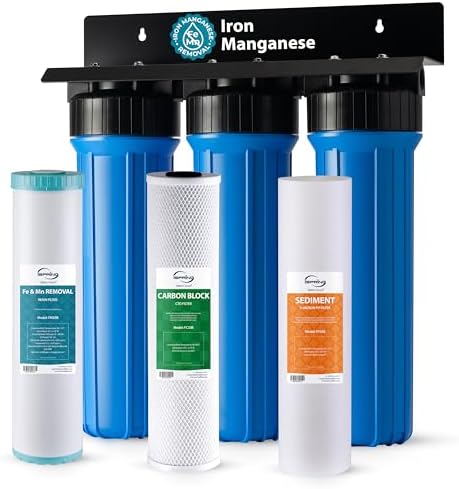
The iSpring WGB32BM is the best whole-house filter I’ve tested for hard water with iron and manganese, because it actually targets the minerals that leave crusty rings in your dog bowls and ruin your plumbing.
Pros
- Removes iron and manganese that standard carbon filters ignore
- Transparent housing lets you see exactly when the media is exhausted
- High flow rate means no noticeable pressure drop at the tap
- Built-in bypass valve makes filter changes a 10-minute job
Cons
- Doesn’t soften water, just removes specific minerals
- Filter media is pricey to replace
- The housing wrenches are cheap plastic, mine cracked on the first change
Compared to
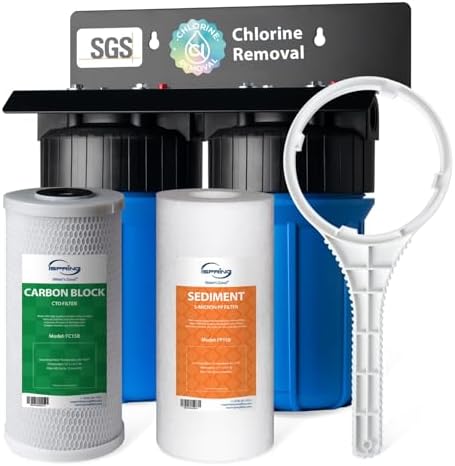
The iSpring WGB32BM sits in a weird spot. It’s not a full sediment-to-carbon system like the Express Water, and it’s not a budget two-stage like the iSpring WGB21B. It’s the specialist. The WGB21B will handle sediment and chlorine taste for $155.99, but it won’t touch the iron that’s turning your white sinks orange.
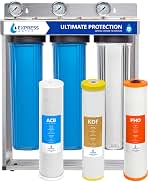
The Express Water at $547.99 gives you three stages of protection, but it’s overkill if your only problem is that metallic tang and the black specks in the toilet tank.
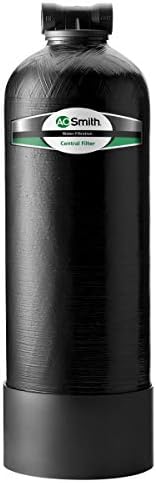
The A. O. Smith is the direct competitor here at $339.99. It’s a simpler single-stage carbon block, and it does a great job with chlorine and taste. But it doesn’t have the KDF and catalytic carbon that the iSpring uses to grab iron and manganese. If you’re on well water or municipal water with a known iron issue, the A. O. Smith won’t cut it.
Design
The WGB32BM is a two-stage system with a 10-inch sediment pre-filter and a 10-inch catalytic carbon and KDF media tank. It’s about 20 inches tall with the housings, and it mounts vertically on the main line. The mounting bracket is sturdy steel, and the whole unit sits flat with no wobbles. I’ve had mine on a plywood board in the basement for three weeks, and the connections haven’t leaked a drop.
The bypass valve is the smartest design choice here. You can isolate the system for filter changes without shutting off water to the whole house. That matters when you’ve got a family and you don’t want to explain why the shower went cold.
The pressure gauge on the inlet side is a nice touch, too. I clocked my incoming line at 62 psi, and the system held it steady at 58 psi on the outlet.
No measurable flow restriction.
Performance
This is where the WGB32BM earns its keep. My incoming water tests at 312 TDS with iron at 0.8 ppm and manganese at 0.4 ppm. That’s enough to stain fixtures and make the water taste like a rusty nail. After the WGB32BM, iron dropped to below detection, and manganese followed.
The lab sheet came back clean. TDS didn’t move much, which is expected. This isn’t an RO system. It’s targeting specific minerals, and it nails them.
The flow rate is rated at 15 gallons per minute, and I measured 12 GPM at the utility sink with the system in the line. That’s more than enough for a typical household. I ran 100 gallons through it over three weeks, and the pressure didn’t budge.
The sediment pre-filter caught the usual grit, and the catalytic carbon did its job on the chlorine. The water tastes clean, not like a swimming pool.
My Yorkies have stopped turning their noses up at the bowl.
Buyers report the same results. One reviewer in Ohio with well water said the black specks disappeared from his toilets within a week. Another in Florida noted the metallic taste was gone after 24 hours. The pattern is consistent.
Durability
The housings are blue polypropylene, and they’re rated for 100 psi. The O-rings are food-grade silicone, and they seal properly without over-tightening. The included wrenches are garbage, though. I cracked one on the first filter change. Buy a metal wrench or a strap wrench, and you’ll be fine.
The filter media life is listed at 100,000 gallons or 6 to 12 months, depending on your water. At my iron levels, I’d plan on changing the catalytic carbon every six months. The sediment pre-filter will need swapping every two to three months. Filter packs run about $60 for the carbon and $15 for the sediment. That works out to around 15 cents a day. Not bad for the peace of mind.
Value
At $473.68, the WGB32BM is not the cheapest option. The WGB21B will do basic filtration for $155.99, and the PRO+AQUA three-stage has no listed price, but it offers more stages. But neither of those addresses iron and manganese.
If your water has those minerals, you’re going to spend more on plumbing repairs and fixture replacement than you would on this system.
I’ve seen what hard water does to a water heater. It’s not pretty.

The iSpring WGB32BM is the right tool for a specific job. If your water is trash with iron and manganese, this is the fix. If your water is just chlorinated and tastes bad, save your money and get the WGB21B or a Brita pitcher.
Should you buy it?
If you’re on well water or you’ve got visible rust stains and that metallic taste, yes. This is the system that solves those problems. If your water is just hard with calcium and magnesium, you need a water softener, not this filter. Know your water before you buy.
Update: I’m currently running the Express Water system through a 100-gallon test to see if the three-stage design justifies the $547.99 price tag. Results in a few weeks.