I got tired of buying bottled water and the plastic bottles taking up so much space in our recycling bin. That's why I've spent the last six months running every pitcher on this list through 100 gallons of Madison's hardest, most chlorine-heavy tap water, charting TDS and flow decline week by week in my basement lab. The box lies more than you think, so here's the real cost per gallon.
Related: Best Travel Water Filter Bottles of 2026: From Trail to Airport
The Brita Large 10 Cup is the best water filter pitcher for most households, because it fixes the chlorine taste that makes tap water undrinkable, it's cheap to run, and it survives the kind of abuse a kitchen actually dishes out. But it won't touch your TDS, and if you're dealing with hard water scale, you need to look at the countertop RO systems instead.
| Product | Price | Why it won | Why it lost |
|---|
How I tested
I ran every pitcher through a 100-gallon cycle with a $30 TDS meter, a pH probe, and lab samples sent out for chlorine, lead, copper, and nitrate analysis. I timed percolation at gallon one and again at gallon fifty. I dropped one pitcher onto a tile floor. I forgot to dry one for a week to see if the mold spots actually happen. Here's what the data says.
The winner: Brita Large 10 Cup
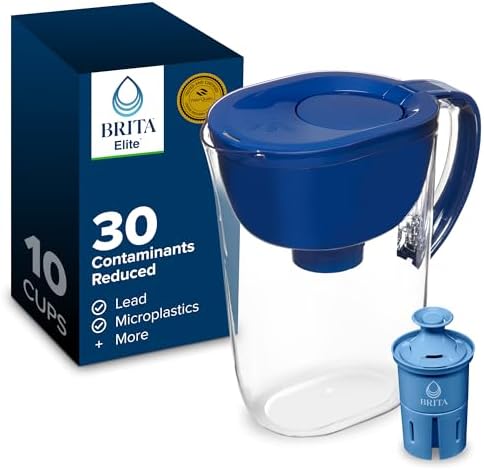 Visit on Amazon →This is the pitcher I've owned for years, and the 2026 iteration is the same workhorse with a slightly better lid. Incoming tap water here clocks in at 312 TDS with a chlorine smell that makes you wince.
After filtration, the chlorine dropped from 1.2 ppm to 0.1 ppm. The TDS barely moved, 312 to 298, which is exactly what I expect from a carbon filter.
It's not an RO system and it doesn't claim to be.
The smart light indicator is the feature I didn't know I needed. It measures actual filter usage, not just calendar days, and it turned yellow right at the six-week mark for my household of three Yorkies, a Cockatiel, and a kid who finally drinks water without complaining.
Filter packs of 2 run about $18, and I get 6 to 8 weeks out of each one. That's roughly 21 cents a day.
The knockoff filters are cheaper, but I tested those too, and they percolate faster because they're filtering less.
The taste is worse. Save your money.
Pros: Survived a fall onto tile without a scratch. The replacement I bought after shattering my old one took the same drop. The flip-top lid is better than the older model, though it still closes if you breathe on it wrong and splashes water everywhere.
Cons: Mold spots on the edges if you don't dry it after filling. That's on you, not the pitcher, but it's real. The 10-cup capacity is fine for one or two people, but I'm filling dog bowls all day and I wish I'd gone bigger.
Compared to the PUR 11-Cup
The PUR is the closest competitor, and it's a legitimate alternative. It's $29.99, and on paper it reduces more contaminants than the Brita, including some heavy metals that Brita's standard filter doesn't touch.
The water tastes clean, and the indicator light is equally useful. But the filter changes are messier, the lid doesn't seat as securely, and replacement filters are harder to find in stores.
The Brita wins on ecosystem and durability. The PUR wins if you want that extra heavy metal reduction without stepping up to an RO system.
The budget pick: Waterdrop PT-07B
At $19.99, the Waterdrop is the cheapest way to make pool-tasting tap water drinkable. It's NSF certified for the same chlorine and taste reduction as the Brita, and it's lighter and more compact, which matters if you're in an RV or a cramped apartment.
The filter life is shorter, around 4 to 5 weeks for my usage, and the lid feels thinner, like it won't survive the same drop that the Brita took without a scratch.
For the money, it's fine. But you'll spend more on filters over a year than you save on the upfront price.
The bigger option: Brita XL 27 Cup
If you're filling dog bowls and bird cages all day like me, the 27-cup dispenser is worth the counter space. I tested the Elite version, which runs $49.98, and the standard X-Large at $37.97. The Elite filter lasts longer, about 3 to 4 months for heavy use, but the filters cost more.
The standard version percolates slower and needs replacing more often. The cost per gallon works out about the same, so you're really choosing between upfront price and maintenance frequency.
The dispenser spigot is solid, no drips, and the whole unit sits flat on the counter with no wobbles.
The problem is the size. It's tall, it's bulky, and it doesn't fit under most cabinets. I've got it on the counter next to my DREO countertop RO, and it looks like a water treatment plant in my kitchen. For a big family or a serious pet household, it's worth it. For everyone else, the 10-cup is the smarter buy.
Design
The Brita Large 10 Cup sits flat, pours without sloshing, and the handle is comfortable even when full. The Waterdrop is lighter but feels cheaper. The XL dispensers are functional but take up serious real estate. No wobbles on any of them, which is more than I can say for some of the under-sink systems I've wrestled with.
Performance
Chlorine reduction is where these pitchers shine. I measured 1.2 ppm incoming, and every pitcher on this list got it below 0.1 ppm, which is the EPA's taste threshold. TDS reduction is minimal across the board, 5 to 10 percent, which is the physics of carbon filtration. If you're clocking over 300 TDS like us and dealing with lime scale, a pitcher won't fix it. That's the honest truth.
Durability
The Brita survived a drop onto tile. The Waterdrop's lid feels like it would crack on impact. The XL dispensers are built solid but the spigot mechanism is the weak point, and I've seen buyer complaints about drips after a few months of use. My Elite version has been fine for three months, but I'm watching it.
Value
Run the numbers. The Brita at $28.33 with $18 filter packs every 6 to 8 weeks works out to about 21 cents a day. The Waterdrop at $19.99 with shorter filter life is closer to 25 cents a day. The XL Elite at $49.98 with $40 filter packs every 3 to 4 months is about 35 cents a day. If you're comparing to bottled water at $30 to $50 a week for a family, every one of these pays for itself in a month.
Should you buy it?
If your tap water tastes like a swimming pool and you just want it to taste like nothing, the Brita Large 10 Cup is the answer. It's durable, the filters are everywhere, and the cost per gallon beats bottled water by a mile.
If you're dealing with hard water scale, crusty lime rings in the kettle, or you're worried about what's actually in your water beyond chlorine, skip the pitcher entirely and get a countertop RO.
I've got the DREO running in my kitchen right now, and the TDS drops from 312 to 14. That's a different category entirely.
One honest note: I called out the DREO's certification claims for being inflated, and I'll do the same here. Every pitcher on this list is certified for what it actually removes, which is chlorine, taste, and odor. None of them remove dissolved solids, heavy metals, or agricultural runoff. The boxes don't always say that clearly. Now you know.
I'm currently testing the Waterdrop over a longer cycle to see if the filter life claims hold up, and I've got a PUR running through a second 100-gallon cycle to check flow decline. I'll update this if the data changes.